Safety First: How to Avoid Entrance Code Violation Risks
The modern residential entrance represents a complex intersection of structural necessity and stringent safety legislation. Every threshold, door assembly, and landing serves as a critical junction subject to the scrutiny of municipal building departments. How to Avoid Entrance Code Violation Risks. Compliance with these standards is not a suggestion; it is a fundamental requirement for the legal occupancy and safety of a residence. When owners ignore the technical requirements of egress or accessibility, they invite severe structural, financial, and legal repercussions.
Professional architects approach entrance design as a systematic alignment with current building codes, such as the International Residential Code. This framework balances life safety—specifically regarding rapid egress during fire events—with the physical demands of long-term structural integrity. Minor deviations in landing height, door swing radius, or handle height can lead to significant delays in project permitting. A rigorous approach to code adherence is the only way to ensure the long-term viability of a home improvement project.
This guide provides a deep, technical look at the regulatory environment governing domestic entryways. It aims to demystify the complex web of local and national requirements, offering owners and designers a framework for proactive compliance. By deconstructing the principles of safe passage, clear egress, and barrier-free movement, the subsequent sections offer a roadmap for navigating the permit process successfully. The focus remains on precision, structural integrity, and the systematic mitigation of regulatory risk.
Understanding “how to avoid entrance code violation risks”
When project managers and owners research how to avoid entrance code violation risks, they often prioritize visual finish quality over technical conformance. This is a profound error. The regulatory code does not differentiate between a high-end luxury installation and a budget renovation; both must meet the same life-safety standards. A common misunderstanding suggests that a local inspector will overlook minor non-compliance if the overall result is aesthetically pleasing. In reality, inspectors follow fixed protocols designed to minimize danger to occupants. Failure to meet simple metrics, like the required floor-to-landing drop or the minimum clear opening width, often triggers a full project stop.
Oversimplification poses another significant danger to the budget and schedule. Many teams assume that a verbal agreement with a local official replaces the need for a detailed, code-stamped plan. This assumption is dangerous. True expertise requires a comprehensive audit of the building’s footprint, the specific egress requirements for that occupancy class, and the local amendments that modify national standards. Learning how to avoid entrance code violation risks requires a systematic, documentation-heavy approach. Designers must anticipate potential conflicts between the desired aesthetic and the legal mandate early in the conceptual phase. The goal is a compliant, high-performance entrance that meets all legal requirements without compromising the architectural vision.
The Problem of Reactive Compliance
Relying on an inspector to point out errors during a final site visit is the most expensive way to manage a project. Elite practices operate with a proactive compliance strategy. They maintain an updated library of relevant code references, ensuring every detail—from the door hardware height to the illumination of the entry path—is vetted long before the first tool is picked up. By acting as forensic planners, they verify that the assembly meets all safety criteria. This approach protects the structure while maintaining the integrity of the design schedule.
Contextual Intelligence and Systemic Balance
Elite firms demonstrate intelligence by acknowledging that the entryway interacts with the broader safety systems of the house. An entry designed for a high-occupancy residence may require different fire-rating protocols than a system intended for a secondary, low-traffic passage. A professional consultant must adjust the mitigation strategy to account for these specific variables. Poor planning here, particularly regarding the orientation of the egress path, can lead to permanent structural liability. The best way to evaluate potential choices is through a rigorous inquiry into the system’s ability to satisfy code while serving the functional needs of the inhabitants.
The Evolution of Life Safety and Building Legislation
The history of residential safety regulations in the United States reflects a shift from primitive, localized ordinances toward the sophisticated, performance-based codes of 2026. This evolution mirrors broader developments in domestic construction, where the home acts as a high-performance system requiring precise environmental and life-safety controls. The movement toward standardized codes represents a demand for structures that protect occupants during extreme events, such as seismic activity or rapid-onset fire.
From Static Passage to Programmable Egress
Contemporary design treats the entryway as an active life-safety barrier. Architects now utilize egress modeling to track potential exit times and clear passage widths within the entrance assembly. This level of oversight ensures that the structural framing remains compliant with fire-access requirements throughout the building’s lifespan. By utilizing sophisticated tracking tools, designers monitor how transitions perform under actual occupancy, ensuring that the assembly functions as a calibrated system rather than a passive, code-noncompliant component.
Material Accuracy and Modern Standards
Engineered transition systems now incorporate clear, code-validated drainage planes and fire-resistance ratings as a baseline requirement. These components allow owners to satisfy safety requirements without relying on custom, unverified installations. By utilizing precision-machined profiles that align with standard code widths, designers ensure that the preparation areas remain legally protected. This level of oversight ensures that high-end homes function as reliable assets within the eye of the building department.
Conceptual Frameworks for Regulatory Compliance
To effectively vet transition hardware, property owners must apply mental models that prioritize safety and legislative endurance.
The Egress-Volume Duality
This framework evaluates every assembly against its dual requirements. Does it satisfy the minimum clear width? Does it promote rapid, unobstructed passage? The model dictates that egress potential is the threshold condition for legal compliance. If a selection—such as an ornamental, non-swinging door leaf—cannot be justified by its contribution to a code-compliant exit, it is considered a severe risk. By treating the ability to exit the residence as a non-negotiable asset, this model prevents the error of creating a trap.
The Barrier-Clearance Hierarchy
This model classifies enclosure variations by their management type: compliant, accessible, or restricted. Each carries distinct operational limits. Accessible options offer the highest compliance level but require wider openings and specialized hardware. Restricted systems provide limited functionality for complex entryways but demand high installation accuracy regarding code heights. Understanding this hierarchy allows the owner to choose the hardware that best matches their volumetric and fiscal requirements.
Taxonomy of Transition Variations
Design partnerships can be categorized by their technical focus and their degree of involvement in the construction phase.
| Service Category | Operational Focus | Primary Trade-off |
| Active Monitoring | Early code-variance detection | Requires permit expertise |
| Passive Drainage | High-reliability code compliance | Complex exterior flashing |
| Vapor Diffusion | Balanced safety adaptation | Sensitive to site location |
| Material Hardening | Fire-resistant structural framing | Higher initial resource cost |
Realistic Decision Logic
The selection of a design partner is dictated by the complexity of the project and the owner’s operational comfort. If a project involves significant structural volume, a partnership with a firm experienced in high-performance code integration is the most effective strategy. If the goal is a highly specific, custom-engineered aesthetic, a studio with an established network of safety specialists often yields the best outcome. The goal remains matching the project’s technical complexity to the system’s core requirements.
Real-World Scenarios: Discovery, Planning, and Execution
Scenario 1: The Landing Height Problem
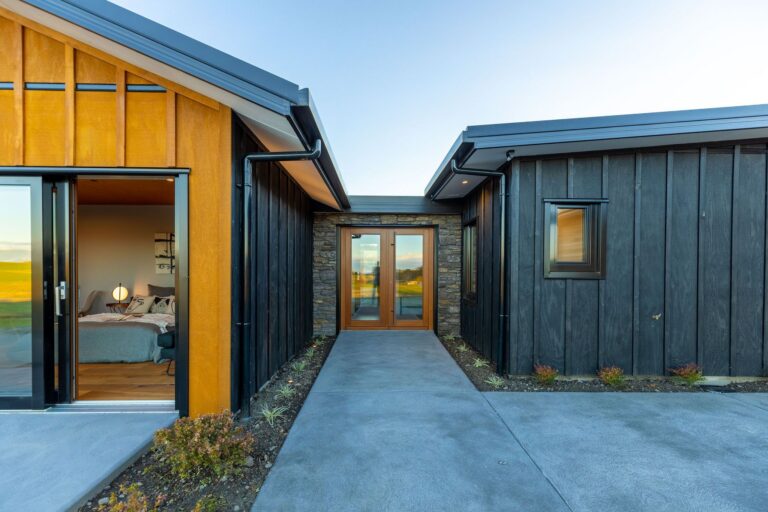
A project requires a complex door-to-exterior transition. The designer must coordinate with the builder to ensure the exterior landing is within code-permitted height relative to the interior floor. The failure mode involves a “threshold error” where the drop exceeds the code maximum, necessitating a costly, non-compliant ramp addition. The mitigation is a formalized installation checklist, where the designer verifies the landing elevation against the local code manual.
Scenario 2: The Egress Width Conflict
During an extensive remodel, the discovery of a structural column reveals that a standard door frame will not fit. The failure mode involves the builder attempting to reduce the width of the door to force a fit, which triggers a code violation for clear egress. The decision point requires the designer to pivot the layout, treating the discovery as a design parameter. The elite professional maintains a pre-negotiated budget allowance for such discoveries, preventing construction delays.
Planning, Cost, and Resource Dynamics
The economic reality of high-end design involves prioritizing the “invisible” safety-compliance labor over the visible exterior finishes.
| Resource Category | Cost Driver | Complexity Index |
| Flashing Precision | Legislative reliability | High |
| Envelope Sourcing | Environmental and code fidelity | High |
| Site Documentation | Planning accuracy | High |
| Exterior Finish | Aesthetic material grade | Moderate |
Investment should follow the utility. Prioritize the time spent in the planning phase. These are the elements that provide the system’s reliability. A reduction in luxury-grade decorative metalwork to accommodate a more thorough, code-heavy planning phase is almost always a superior strategy for maintaining the project’s value.
Tools, Strategies, and Support Systems
The successful specification of a project relies on a range of analytical tools utilized by the professional:
-
Code-Mapping: Creating a digital 3D model of the site to identify intensity distribution before finalizing plans.
-
Integrated Submittal Logs: Maintaining a centralized, date-stamped record of all safety-sensitive material specifications.
-
Phased Site Verification: Conducting critical-point inspections during the construction phase to ensure the build aligns with the performance specs.
-
Component-Level Degradation Audits: Calculating the performance requirements of every flashing to ensure consistency across the entire residence.
Risk Landscape and Failure Modes
The failure of a modern transition system is rarely a sudden event. It is the accumulation of systemic oversights that occur in the design phase.
-
Dimensional Mismatch: Occurring when flashing dimensions do not match the wall plenum, leading to costly and invasive site modifications.
-
The “Invisible” Thermal Conflict: Common in high-end projects where excessive interior humidity is placed against a cold exterior, leading to localized condensation.
-
Tape Incompatibility: The cumulative effect of choosing high-fidelity tapes that do not communicate properly with the building’s existing surface finishes.
Governance, Maintenance, and Long-Term Adaptation
A high-functioning transition is a technical asset that requires formal management.
Establishing Maintenance Protocols
-
Periodic Integrity Checks: Measuring air-sealing levels annually accounts for normal building settling over time.
-
Sealant Validation: Inspecting mechanical barriers and edge connections for signs of excess wear or material degradation every 24 months.
-
Adjustment Triggers: Establishing clear thresholds for mechanical function, such as when pressure-boundary performance drops below the design baseline, requiring immediate resealing.
Measurement, Performance Signals, and Evaluation
Success in modern design is measured by the silence and reliability of the operation.
-
Leading Indicators: The ease of interaction during daily use, the complete absence of stains or rot, and the perfect alignment of every exhaust path.
-
Lagging Indicators: The total lack of service-related repairs, and the longevity of the moisture-barrier modules and control drivers.
-
Qualitative Signals: The subjective sense of a responsive space, where the layout supports intended workflows without air-pressure issues.
Common Misconceptions and Oversimplifications
-
The “Inspector-Approval” Fallacy: The belief that approval implies compliance. An inspector may miss a detail that later becomes a liability in a legal event.
-
Extraction Over-Optimization: Attempting to hide every single component often leads to a room that feels “flat” and devoid of necessary visual texture.
-
The “Sealant-Fixes-All” Myth: Sealant is useful but cannot fix a fundamentally flawed, porous material choice.
-
Hardware Neglect: Viewing silencers and drivers as secondary. In high-performance systems, the mechanical control elements are the primary determinants of the user experience.
Ethical, Practical, and Contextual Considerations
The ethical dimension of architectural design lies in the longevity of the built environment. Creating systems that require constant, energy-intensive repair is inherently wasteful. By choosing designs that prioritize natural durability and ease of maintenance, architects and owners demonstrate a commitment to both fiscal and environmental responsibility. This approach ensures that the home remains a sustainable asset, capable of serving future generations without becoming a source of systemic stress.
Conclusion
Selecting the elite path for your next home project is fundamentally a balancing act between structural rigor, electrical efficiency, and atmospheric clarity. By prioritizing the invisible, utility-based requirements of the environment, homeowners create a foundational asset that supports the evolving needs of their lives. The future of the domestic hub lies in the integration of even more sophisticated, concealed sensors and the use of handlers that combine extreme performance with refined spectral output. Those who approach the entry environment as a complex architectural problem rather than an aesthetic accessory achieve the highest degree of long-term utility, ensuring their homes remain high-performance environments for generations.