Architectural Arrivals: Exploring Top Foyer Entrance Styles America
The residential entry functions as the primary atmospheric bridge between the chaotic exterior environment and the curated interior. It represents the architectural manifestation of a threshold, where the building must reconcile competing requirements regarding security, thermal performance, and human experience. When executed with precision, this space transcends its utilitarian function. Top Foyer Entrance Styles America. It becomes a sensory gateway, framing the narrative of the home before any interior room is occupied. The challenge in modern residential design involves maintaining this narrative clarity while adhering to complex technical constraints.
The contemporary landscape of high-end residential construction has shifted toward a requirement for systemic integration. No longer a collection of disparate decorative elements, the premium foyer is now a highly engineered assembly. It must manage moisture, airflow, and structural movement with absolute reliability. Failure in this domain is rarely limited to aesthetic disappointment. It often results in compromised building health, increased energy loss, and accelerated material degradation. The most successful projects prioritize this systemic integrity, treating the entrance as a critical component of the building’s overall performance.
This analysis deconstructs the methodology of high-performance entry design, exploring the intersection of architectural theory and structural engineering. It moves beyond common surface-level trends to investigate the principles of scale, circulation, and material science that define enduring quality. By prioritizing evidence-based planning and rigorous execution, this resource serves as a definitive guide for those seeking to understand the complexities and the potential of modern residential arrivals.
Understanding “top foyer entrance styles america”
When professionals and homeowners examine top foyer entrance styles america, they often find that the most successful projects prioritize spatial hierarchy over mere opulence. A common misunderstanding suggests that a specific style is achieved through the application of generic finishes. While stone floors or brass hardware contribute to the visual experience, they do not inherently create a successful entryway. True excellence resides in the management of human movement and the calibrated transition between exterior and interior volumes.
The Dynamics of Spatial Hierarchy
If the circulation remains awkward, or if the transition lacks a sense of intentionality, no amount of decorative cladding will salvage the design. The fundamental goal of high-end practice involves creating a space that feels both welcoming and secure. Architecture itself directs the user intuitively through the house.
Oversimplification remains a primary threat to long-term project viability. Many teams treat the entry as a static visual set-piece rather than a kinetic system. High-end standards require a deep commitment to forensic planning, where every structural and mechanical detail is vetted against the site’s unique environmental conditions.
Forensic Planning and Operational Integrity
A designer might specify a high-performance pivot door, for instance, but fail to account for the necessary floor-recessed door closer. Impact from wind-pressure on the door’s operation must also be considered. These oversights, while seemingly minor during the drawing phase, compound into significant operational failures during the occupancy phase. To master this design category, one must reconcile aesthetic intent with the rigid laws of physics. Reliability performs as well as beauty.
Historical Evolution of Domestic Arrival
The history of the American entryway traces a trajectory from the utilitarian, covered porches of early colonial structures to the expansive, highly integrated foyers of the 2026 high-performance home. This evolution reflects broader shifts in domestic life, moving from a model of strict room segregation to one of fluidity and transparency. In the early 20th century, the foyer functioned primarily as a buffer against the elements, a cold-storage transition zone for outdoor clothing and equipment.
The Shift Toward Fluidity
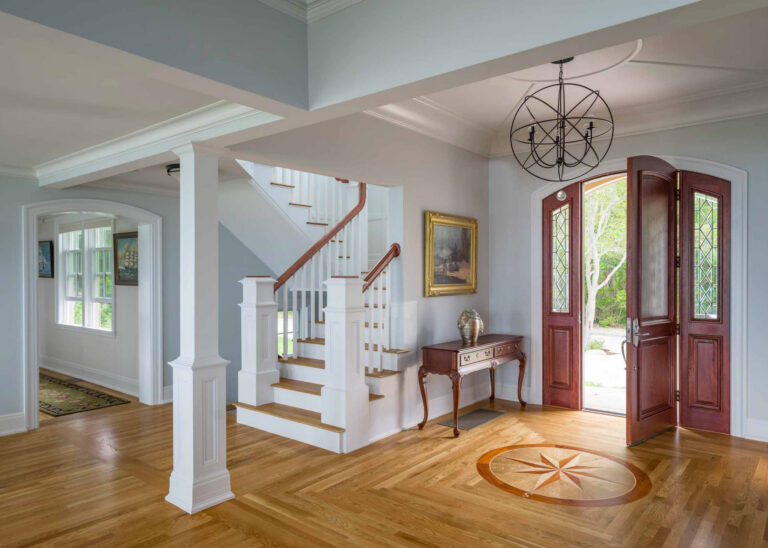
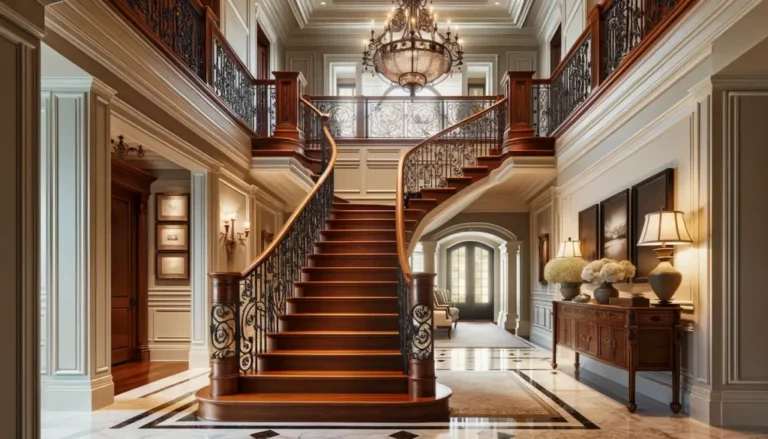
With the advent of the open-plan movement, the foyer was gradually integrated into the broader living space. The wall-enclosed entrance of the past was replaced by the open, double-height foyer, designed to showcase the home’s interior scale immediately upon entry. This shift necessitated a re-evaluation of the foyer’s purpose; it became less about the physical storage of outdoor gear and more about the immediate presentation of the home’s aesthetic identity.
Modern Requirements for Performance
In the present era, the luxury entryway has returned to a more nuanced state of dual-utility. Modern residents demand a space that is both visually grand and practically performative. This involves the integration of high-performance air-sealing, automated security systems, and hidden storage solutions that maintain the minimalist aesthetic while serving the requirements of a high-traffic daily life. The contemporary foyer is now expected to be both a gallery-like space and a highly efficient, climate-controlled transition zone.
Conceptual Frameworks for Spatial Flow
To evaluate potential design choices, professionals apply mental models that balance aesthetics with functional longevity.
The Compression-Expansion Framework
This model dictates that a sense of arrival is amplified by a shift in scale. By compressing the entry path—perhaps through a lower canopy or a narrow transition corridor—the subsequent release into the main foyer volume feels more dramatic. This contrast is a fundamental tool in top foyer entrance styles america, allowing architects to create emotional impact without needing large-scale architectural additions.
The Material Continuity Model
This framework suggests that visual unity is achieved when materials flow seamlessly from the exterior to the interior. The continuation of stone flooring from a porch into a foyer creates a blur between indoor and outdoor spaces, effectively expanding the perceived area of the entrance. This model highlights the importance of choosing exterior-grade materials that also meet the aesthetic and durability standards of an interior space.
Taxonomy of Transition Variations and Trade-offs
Design partnerships are characterized by their technical focus and their degree of involvement in the construction phase.
| Service Category | Operational Focus | Primary Trade-off |
| Integrated Minimalist | Visual silence, precise detailing | Requires extreme installation accuracy |
| Traditional Symmetrical | Timeless proportion, stability | Less flexibility for modern open plans |
| Material-Driven Hybrid | Texture, sensory experience | Higher maintenance, complex cleaning |
| Technologically Active | Security, automation, climate | Higher maintenance, system complexity |
Realistic Decision Logic
The selection of a design strategy is dictated by the specific context of the project and the client’s long-term operational comfort. If a project requires a highly seamless aesthetic, a strategy favoring integrated, flush-mount hardware and concealed detailing is the most effective choice. Conversely, if the client prioritizes ease of use and long-term durability, a more robust, material-focused approach with clear, defined transition zones often yields the best outcome. The objective is to align the project’s technical complexity with the anticipated intensity of daily use.
Real-World Scenarios: Discovery, Planning, and Execution
Scenario 1: The Pivot Door and Structural Loading
A high-end project specifies a floor-to-ceiling glass-and-steel pivot door. The challenge arises in the structural requirement for the door closer, which must be recessed into the finished floor. The failure mode involves a conflict between the radiant floor heating pipes and the door closer box. The mitigation is a highly coordinated BIM process that resolves the subfloor assembly long before the materials reach the site.
Scenario 2: The Acoustic Boundary
An open-plan foyer connects directly to a high-traffic kitchen, leading to unwanted sound transfer. The solution requires the strategic use of high-mass acoustic panels integrated into the walls, or the use of soft, sound-absorbing materials like wool rugs and textured wall coverings. The second-order effect is a significant improvement in the perceived quality of the space, as the reduction in noise enhances the sense of calm.
Resource Dynamics, Cost Structures, and Lifecycle Value
The economic reality of high-end design involves prioritizing the invisible spatial planning labor over the visible finishing touches.
| Resource Category | Cost Driver | Complexity Index |
| Substrate Preparation | Construction precision | High |
| Component Sourcing | Material fidelity/durability | High |
| Site Documentation | Planning accuracy | High |
| Finish Trim Labor | Manual installation time | Moderate |
Investment should follow the utility. Prioritize the time spent in the planning phase. These are the elements that provide the system’s reliability. A reduction in luxury-grade decorative trim to accommodate a more thorough, engineering-heavy planning phase is almost always a superior strategy for maintaining the project’s financial value.
Tools, Strategies, and Support Systems
The successful specification of a project relies on a range of analytical tools utilized by the professional:
-
Digital Clash Detection: Creating a digital 3D model to identify installation bottlenecks before finalizing plans.
-
Integrated Submittal Logs: Maintaining a centralized, date-stamped record of all flooring, molding, and hardware specifications.
-
Phased Site Verification: Conducting critical-point inspections during the construction phase to ensure the build aligns with the performance specs.
-
Standardized Detail Libraries: Calculating the performance requirements of every transition to ensure consistency across the entire footprint.
The Risk Landscape: Identifying Compounding Failures
The failure of a modern transition system is rarely a sudden event. It is the accumulation of systemic oversights that occur in the design phase.
Dimensional Mismatch and Acoustic Conflicts
Dimensional mismatch occurs when flooring heights do not match door clearances, leading to invasive, last-minute modifications. The invisible acoustic conflict remains common in luxury homes where excessive openness leads to sound transmission. This issue necessitates late-stage remediation to quiet the affected rooms.
Adhesive Incompatibility
Adhesive incompatibility represents the cumulative effect of choosing high-fidelity finishes. These materials often fail to communicate properly with the building’s subfloor chemistry. Such chemical mismatches inevitably compromise the structural integrity of the foyer floor.
Governance, Maintenance, and Long-Term Adaptation
A high-functioning interior is a technical asset that requires formal management.
Establishing Maintenance Protocols
-
Periodic Stability Checks: Measuring joint-to-subfloor alignment annually accounts for normal building settling over time.
-
Joint Validation: Inspecting chemical barriers and surface connections for signs of excess stress or material degradation every 24 months.
-
Adjustment Triggers: Establishing clear thresholds for mechanical function, such as when pivot-hinge or automated-door performance drops below the baseline.
Measurement, Performance Signals, and Analytical Evaluation
Success in modern movement is measured by the silence and reliability of the operation.
-
Leading Indicators: The ease of traversal during daily use, the complete absence of visual telegraphing, and the perfect alignment of every edge.
-
Lagging Indicators: The total lack of service-related repairs, and the longevity of the mechanical bonds and control drivers.
-
Qualitative Signals: The subjective sense of a responsive space, where the layout supports intended movement without visual noise.
Industry Misconceptions and Structural Oversimplifications
-
The Material-Fixes-All Fallacy: A high-end stone or wood is useful but cannot fix a fundamentally flawed, weak circulation plan.
-
Transition Over-Optimization: Attempting to hide every single joint often leads to a room that feels flat and devoid of necessary visual rhythm.
-
The More Space Is Better Myth: A cavernous foyer that lacks a relationship to human scale feels institutional, not luxurious.
-
Hardware Neglect: Viewing fasteners and backing as secondary. In high-performance systems, the mechanical control elements are the primary determinants of the user experience.
Strategic Synthesis and Future Engineering Pathways
Selecting the elite path for your next home project is fundamentally a balancing act between structural rigor, material efficiency, and visual clarity. By prioritizing the invisible, utility-based requirements of the environment, homeowners create a foundational asset that supports the evolving needs of their lives. The future of the domestic hub lies in the integration of even more sophisticated, sustainable transition solutions and the use of materials that combine extreme performance with refined spectral output. Those who approach the living environment as a complex architectural problem rather than an aesthetic accessory achieve the highest degree of long-term utility, ensuring their homes remain high-performance environments for generations.